
Project 3

Exploring Steady States and Growth Dynamics in the Solow Model - Victor Bogin
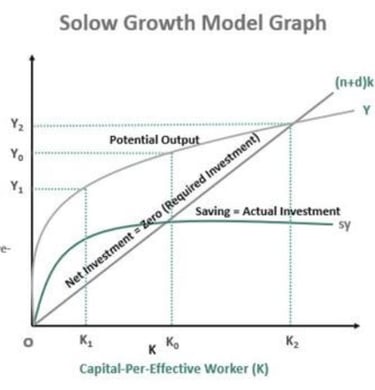
This project analyzes the Solow growth model by examining how capital, output, and consumption evolve toward steady states under different economic conditions. In the first part, the study explores how capital per effective worker approaches a steady-state level, calculated as 4.218. Through graphical analysis, it demonstrates that both the natural logs of aggregate capital and capital per worker exhibit near-linear relationships, confirming the consistency of their growth rates. The model’s behavior aligns with theoretical expectations, where the growth rate of capital per worker approaches the parameter γ (0.9), while aggregate capital grows slightly faster at γ + η.
The second part investigates the Golden Rule level of capital, focusing on how changing the savings rate alters steady states and long-term outcomes. When the savings rate shifts at period 50, capital per effective worker converges from the higher steady state (4.21) to a lower one (2.92). Correspondingly, output per effective worker decreases to its new equilibrium. However, because the new savings rate equals the output elasticity (α), consumption per worker initially rises—reflecting higher short-term consumption from reduced savings—before stabilizing at a slightly higher level in the long run.
The third part examines the impact of increasing technological growth, denoted as Double Gamma Tilda, on economic performance. When the rate of technological progress rises, capital per effective worker declines due to the denominator effect in the model’s formulation, which in turn reduces output per effective worker despite the boost in technology. Graphs of aggregate output and output per worker show a modest acceleration in growth after the change, although initial worker productivity drops before gradually recovering. Overall, the project illustrates the Solow model’s central insight: long-term growth depends critically on technological progress, savings behavior, and steady-state capital accumulation dynamics.